
Lessons from the Ashram
A mental and physical break while backpacking Asia turned into a spiritual awakening

Why I decided to go to an ashram
Four months ago I left my job and my life in New York City and headed for my motherland in India. While I was staying with some relatives I picked up a book called ‘Karma Sannyasa.’ It’s a spiritual book which follows the Vedanta philosophy that is about developing a higher awareness in order to live a full life, not through renunciation but through a balanced approach to action and detachment. Reading it, I realized there is a whole world I had only scratched the surface of— my spirituality. The book suggests spending time in an ashram for as little as a few days a year to rejuvenate physically, emotionally and spiritually. Part of the intention with my sabbatical was to do exactly that, and through it develop a stronger sense of self. A strong signal inside of me went off. How and when I would stay at an Ashram in Asia? I had no clue yet.
Weeks later I learned about the Sivananda ashram from a lovely Australian yoga teacher and radio producer named Donna. It’s part of the Vedanta philosophy and teaches classical yoga, meditation and they have centers all over the world. And it was cheap! One word that will make any backpacker’s ears perk up. I stored that information in the back of my mind.
Then I learned from a fellow traveler while in Northern Vietnam that Da Lat was one of their favorite places in the country. It’s a region in the highlands of Southern Vietnam known for it’s unique natural beauty; tropical fauna, pine trees from the French colonial era, and coffee plantations for hundreds of kilometers. Turns out Da Lat was one of the two Sivananda locations in Vietnam. Ah ha!
I booked 5 nights by myself without a clue of what I was getting into. But I had this strong sense that I needed to listen to that signal inside of me and I’m so grateful that I did. Funny enough, I met two amazing women on their own healing journey’s in the last two weeks in Vietnam and when I told them about my plans they decided to drop everything to join me. They had full faith in me, and I did too.
Five days of daily chanting, meditating, workshops and physical yoga had a tremendous affect on me. I had a deep spiritual awakening and now feel motivated to start my sadhana (daily spiritual practice) so I can be the most creative, fulfilled, selfless and loving being I can possibly be in this lifetime. When my mind went still I could see my purpose. In that light-filled quiet moment I could hear a voice tell me exactly how I could achieve it. I left yesterday with a heavy heart but a feeling that I will be returning very soon…
My lessons
Embody Swami Sivananda’s core beliefs
Swami Sivananda’s says that if we can “adapt, adjust, accommodate, meditate and realize,” we are on the path to live a balanced life.
Create your Sadhana, meaning your daily spiritual practice.
Do asana yoga, physical movement, everyday (ideally for 2-4 hours).
When doing asana yoga you exert your energy by doing the poses, but then after holding each pose you go into Sivasana (corpse pose). This mimics real life which is a constant cycle of hard work and rest. You always know something difficult is around the corner, just as you know you’ll be able to rest afterwards. Even if it’s just brief.
Start meditating and chanting (ideally morning and night).
Kapalbhati (forceful exhalations) purifies the respiratory system. Pranayama stimulates the right and left side of your brain and helps you think clearly and positively. It also balances your masculine and feminine energy (yin and yang).
It’s incredible how powerful mantras and kirtans, devotional chanting, can be. Even just playing it on YouTube in the mornings or before you go to bed will have a positive affect on you. See here for the ‘Jaya Ganesha’ kirtan we sung twice a day.
We all have Karma, meaning spiritual ignorance of ones true-self even in past lives. It is our duty to practice Karma Yoga, selfless acts of service without any expectations, in order to purify it.
Serve others— even your enemies. It is our duty. We can apply this to our work lives: it is our duty to serve our clients, customers even micromanaging managers. Accept this and do it with love.
Keeping a satvic diet. This is a vegetarian-based dietary practice rooted in Ayurveda, focusing on foods believed to promote purity, calmness, and mental clarity. This means cutting out caffeine, meat, candy, alcohol, garlic, onion and mushrooms.
When it comes to food, really think whether you are hungry or not before eating. Once you’re eating, eat slowly and mindfully. When you chew your foods thoroughly you release more saliva which in turn helps the food digest properly. Don’t talk and eat. Savor every bite. When you’re full, stop. You only need to eat very little to get the necessary nutrients.
Learn about Vedanta and Hindu philosophy. You can watch teachings on YouTube and listen to podcasts about it for free. Really reflect on the learnings and embody it.
Start this and be consistent with it.
See stress as a guru
He is a disciplined and compassionate guru because he helps us understand the issues within us so we can be better sentient beings. When you’re feeling stressed, stop, listen and introspect.
5 causes of stress:
Low level of energy and negative habits
Inability to adapt. You get sucked into the “it’s too hard I can’t do it” mentality.
Existential anxiety about the state of the world.
The answer to relieving stress is to seek nature and trust in the Sivananda-Vedanta philosophy. Tell the stress “thank you” for giving me this lesson. Remind yourself of Sivananda’s core beliefs: adapt, adjust, accommodate, meditate and realize.
Stay present
Swami Sivananda emphasizes that living in the present moment is crucial for happiness, freedom, and spiritual growth. By staying present, one can experience joy, utilize every moment effectively and find solutions to problems.
Leave the past in the past. You create more suffering for yourself when you hold onto the past. You’re holding onto your past impressions, what the mind has experienced in this lifetime and previous ones.
Let go of future thinking. It’s our own desire to control what is uncontrollable. Things will unfold the way they are meant to. Believe that.
You are not your mind. Don’t say “I think” instead say, “my mind has the tendency to act anxious, angry, worried, etc.” Detach from your own mind and it’s thoughts.
Our fears are just our imagination. They’re not real.
Detach from your attachments
Detach from the ego, known as our fake self, which is bound to desires and attachments.
Attachments are relationships, possessions, even ideas of how we need to live in order to be happy. “I need x amount of money by x age… I need to be married with a kid by x age.” We loose ourselves in the pursuits of our ego’s attachments until we become a slave to them. We need to disconnect and detach from all of it. Once we do, we will be more in line with our true self.
Being detached doesn’t mean disconnecting from the people around you and relinquishing your possessions. It means you are unaffected in the face of trials and tribulations of life. You’re building resilience.
We attach to our ego because of our spiritual ignorance. We don’t feel whole so we identify with what is lacking and imperfect. But remember, you are perfect. Say this mantra: “I am perfect. I am pure love.”
Self love and relationships
Bhakti yoga is the path of transforming emotions into devotion. This is the path of love.
Pure, unconditional love which is not bound by ego, desires or expectations is our highest goal in life. This is known as Atman.
All relationships in life are karmic, meaning they are not by accident or coincidental. It happened so you can learn from it. You’ve attracted these people in a past life. iIf they brought our or caused pain to you it’s your duty to introspect and do your sadhana so you can purify that karma. Look at the patterns in your relationships— are you attracting a different person with the same characteristics and endings?
The moment you stop blaming others and turn inward is when your self-healing journey begins. You go from victim to warrior.
Your relationships are an opportunity to practice selfless love and karma yoga.
Self love and selfless love needs to be learned. Say the mantra “I am pure love. I am absolute bliss. I am knowledge.” This is your essential nature.
Pleasure also gives us pain. Accept this and practice detachment so you are unaffected and remain calm in challenging moments.
Remember, nothing is forever. And the only constant in life is impermanence.
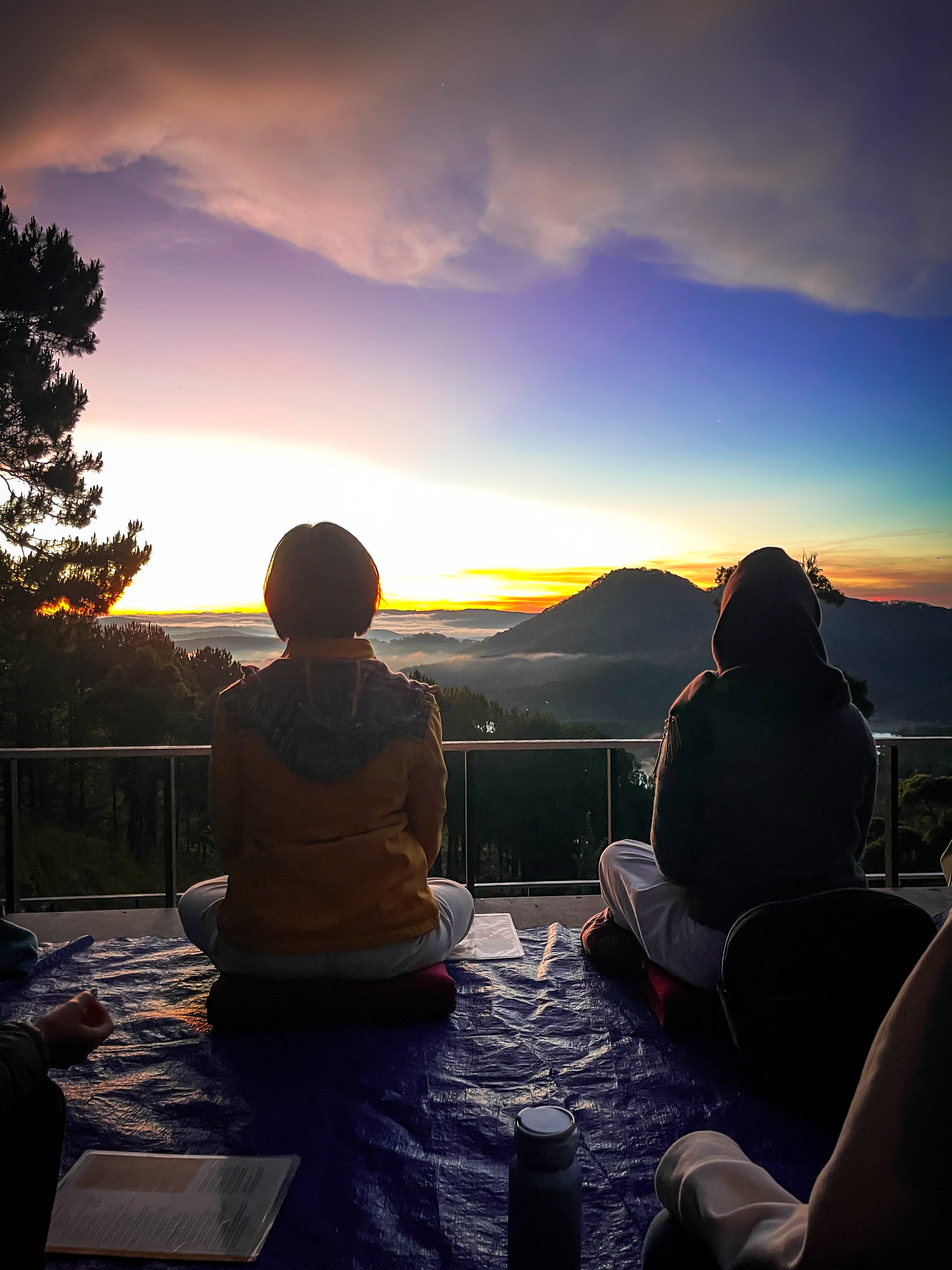
Here is a little snippet from Sunday morning’s Satsang above the clouds, 5,500ft above sea level. I’ll never forget this beautiful moment.
I hope you can take a few of these learnings into your own lives. Find what works for you and leave what doesn’t. I hope this motivates you to start your healing journey, or maybe continue and deepen it. This lifetime is short, and why stay in spiritual ignorance when there is a whole world out there full of love and happiness? It’s ours to take, we just have to reach for it.
I’m in amazement following you on your path!
In full admiration, PapaWitty
India, I love how beautifully you captured everything we learned at the ashram. I’m so grateful to have experienced this journey with you. I’ll always return to your blog post as a reminder of the key insights we explored during the retreat.